
Why Choose LED Street Lights for Global Projects?
Choosing LED street lights for global projects requires more than replacing old lamps with brighter fixtures. It demands evidence, local knowledge, and disciplined planning. A road in a humid coastal city faces salt exposure, while a mountain route may face freezing temperatures, snow, and unstable maintenance access. Each location needs suitable ingress protection, thermal management, surge protection, optics, and control systems.
Roland Haitz, a physicist and LED industry pioneer, stated, “For every decade, the cost per lumen of an LED decreases by a factor of 10, while the amount of light generated by an LED package increases by a factor of 20.” His observation explains why LED technology has become practical for large infrastructure programs. However, efficiency alone does not guarantee success. Project teams should verify photometric files, roadway classifications, uniformity, glare control, color temperature, and expected lumen maintenance. They should also examine total ownership costs, including energy, inspections, replacement access, and disposal.
The details matter.
A well-designed installation can reduce dark patches, improve visibility at intersections, and support adaptive dimming during quiet hours. Yet some projects still over-light streets or select products by price alone. That approach deserves reflection. A lower purchase cost may hide weak warranties, poor drivers, or expensive maintenance. Reliable suppliers should provide test reports, clear performance data, local service capacity, and realistic guarantees. With careful field trials and measurable results, LED street lights can offer durable value across different climates, road designs, and public budgets.
What Are LED Street Lights and How Do They Work?
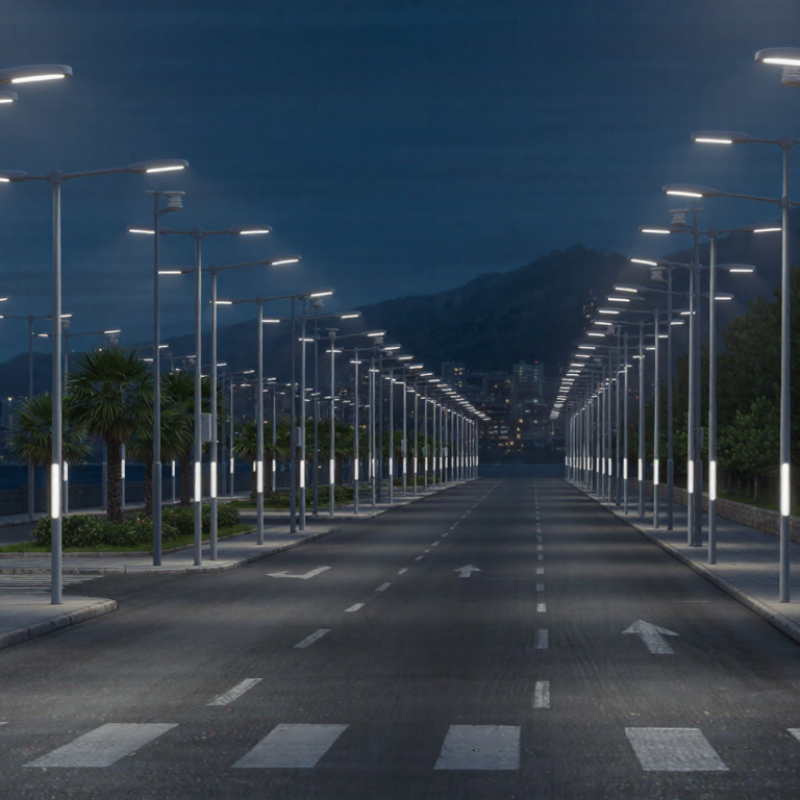
LED street lights are outdoor luminaires that use light-emitting diodes to produce illumination. Unlike older lamps, LEDs create light when electrical current passes through a semiconductor. The process generates less wasted heat, although heat still requires careful control. A driver converts incoming power into a stable current for the LED chips. This protects performance during voltage changes. Optical lenses then shape the beam across the road, sidewalk, or junction.
A typical installation may include a photocell, timer, or network controller. These controls can dim lights during quiet hours and increase output near busy crossings. Engineers should check road width, pole spacing, mounting height, and local lighting standards before selecting a fixture. A narrow street may need a different beam pattern from a wide highway. Climate also matters. Sealed housings help resist rain and dust, while surge protection supports reliability during storms.
In field projects, maintenance teams often inspect connectors, lenses, and pole alignment during scheduled visits. Small faults can reduce useful light before the failure becomes obvious. LED systems are efficient, but they are not flawless. Poor thermal design can shorten service life. Excessive brightness may also create glare for drivers and residents. Careful testing remains necessary, especially when projects cross regions with different grids, weather conditions, and maintenance skills. Kenya, Norway, and coastal cities do not present the same lighting problem.
Why Choose LED Street Lights for Global Projects? - What Are LED Street Lights and How Do They Work?
| Evaluation Dimension | LED Street Lights | Conventional Roadway Lighting | Global Project Relevance |
|---|---|---|---|
| Definition | A roadway luminaire that uses light-emitting diodes (LEDs) as its light source. | Commonly uses high-pressure sodium, metal-halide, or other gas-discharge lamps. | LEDs provide a compact, controllable platform that can be adapted to different road classes, climates, and grid conditions. |
| How It Produces Light | Electric current passes through semiconductor material, causing photons to be emitted. A driver regulates the current and voltage. | An electrical discharge excites gas or metal vapor inside a lamp, which then emits light. | The LED system can be designed for stable operation across a wide range of supply voltages and control requirements. |
| Typical Luminaire Efficacy | Approximately 100–200 lumens per watt for many modern roadway luminaires, depending on optics, temperature, and operating conditions. | Often approximately 60–140 lumens per watt at the luminaire level, depending on lamp type and system design. | Higher efficacy can reduce installed power while maintaining required road illumination. |
| Typical System Power | Approximately 30–180 W for many urban and highway applications; final power depends on mounting height, spacing, road width, and lighting class. | Approximately 70–400 W, including common lamp and ballast combinations used for comparable roadway applications. | A photometric design is required before claiming a specific energy reduction. |
| Potential Energy Reduction | About 40–70% compared with many older, non-optimized roadway lighting systems when lighting levels and operating schedules are properly designed. | Generally requires more input power for comparable useful illumination, especially in older installations. | Lower electricity consumption can support operating-cost and carbon-reduction targets. |
| Rated Useful Life | Commonly 50,000–100,000 operating hours, normally expressed using an LED lumen-maintenance rating such as L70. | Many conventional lamps require replacement after approximately 10,000–30,000 hours, depending on lamp technology and operating cycle. | Longer service intervals are valuable for remote roads, bridges, and areas with high maintenance costs. |
| Light Distribution | Individual LEDs and precision optics direct light toward the carriageway, reducing unnecessary upward and sideways light. | Lamp output is commonly broader, with more light controlled by reflectors and refractors. | Better optical control can improve uniformity and reduce glare when the product is correctly selected and installed. |
| Color Rendering Index | Commonly CRI 70–90, with many roadway products designed around CRI 70 or higher. | High-pressure sodium is commonly around CRI 20–30; metal-halide sources can provide higher CRI but may have shorter life and higher maintenance requirements. | Improved color recognition can support traffic safety, pedestrian visibility, and security monitoring. |
| Color Temperature Options | Common choices include 2,200–3,000 K for warmer light and 3,000–4,000 K for general roadway applications. | Options depend largely on the selected lamp technology and are generally less flexible after installation. | Color temperature can be selected according to local regulations, community preferences, wildlife sensitivity, and road function. |
| Start-Up and Dimming | Instant start-up and electronic dimming are standard design possibilities; control compatibility depends on the driver and system architecture. | Some discharge lamps require warm-up and restrike time, and dimming can be more limited. | Adaptive dimming, scheduling, and fault reporting can reduce energy use during low-traffic periods. |
| Thermal Management | Heat is conducted from the LED board to a heat sink and released through the luminaire housing. Thermal design strongly affects service life. | Lamp, ballast, and enclosure temperatures also affect performance, but the system has a different thermal structure. | Projects in hot climates should verify ambient-temperature ratings, heat-sink design, and lumen-maintenance data. |
| Environmental Protection | Outdoor luminaires are commonly specified with IP65 or IP66 protection; impact ratings such as IK08 or IK09 may also be required. | Protection levels vary by housing and installation, and older equipment may have degraded seals. | Ingress and impact ratings should match local rain, dust, salt spray, vandalism, and maintenance conditions. |
| Power Quality | A suitable driver can provide power factor of 0.90 or higher and total harmonic distortion below 20%; actual values must be verified from product test data. | Ballast performance varies by lamp age, design, and installation condition. | Power-quality requirements are important where electrical networks are weak or utility standards are strict. |
| Surge Protection | External or integrated surge protection of 6–10 kV is commonly specified for outdoor roadway applications, subject to local risk assessment. | Protection depends on the existing ballast, wiring, grounding, and distribution equipment. | Surge protection is especially relevant in regions with frequent lightning, overhead networks, or unstable grid conditions. |
| Maintenance Requirements | Usually fewer scheduled lamp replacements; periodic cleaning, inspection, electrical testing, and driver replacement may still be required. | More frequent lamp and ballast maintenance is commonly required over the installation life. | Reduced maintenance visits can lower traffic-management costs and improve uptime. |
| Control and Connectivity | Can support photocells, astronomical timers, 0–10 V or DALI dimming, motion detection, and networked monitoring when compatible components are used. | Control options are often limited by lamp and ballast characteristics. | Smart controls can enable asset management, scheduled dimming, energy measurement, and remote fault alerts. |
| Recommended Design Process | Use photometric files, road geometry, mounting data, lighting-class requirements, glare limits, and energy calculations. | Replacement projects may begin with existing pole spacing and lamp wattage, but these may not represent current lighting requirements. | A compliant lighting simulation is more reliable than selecting fixtures by wattage alone. |
| Key Selection Checks | Verify photometric performance, lumen maintenance, driver life, operating temperature, IP and IK ratings, surge protection, controls, certifications, warranty terms, and spare-part availability. | Verify lamp availability, ballast compatibility, replacement cycles, energy consumption, and condition of existing poles and wiring. | Local standards, utility requirements, climate, logistics, maintenance capability, and total cost of ownership should guide the final specification. |
Note: Performance ranges are typical industry values and vary with luminaire design, operating temperature, installation geometry, lighting standards, control schedules, and maintenance practices. Final project values should be confirmed through a photometric study and verified technical documentation.
Related Posts
-
What Are the Top LED Street Lights for Global Buyers?
-
2024's Ultimate Guide: 15 Best Solar LED Lights for Sustainable Energy Savings
-

Unlocking Sustainability with Solar LED Lights Advantages for Your Home and Business
-

Transform Your Neighborhood with Innovative Solar Street Lights: A Sustainable Solution for Safer Streets
-

Top 10 Solar Lights in 2025 for Efficient Outdoor Illumination
-
2026 Best LED Street Lights Reviews and Buying Guide
