
What Are the Top LED Street Lights for Global Buyers?
Choosing the right LED street lights is not a simple matter of comparing wattage or purchase prices. Global buyers must examine roadway width, traffic speed, climate, mounting height, maintenance access, and local lighting requirements. A coastal road may need stronger corrosion protection, while a cold northern highway demands reliable starting performance and thermal control. Small details matter.
Dr. John Bullough, a respected lighting researcher, offers a useful principle: “Street lighting should serve people, not merely satisfy a specification.” That idea should guide every international purchasing decision. High-quality LED street lights should distribute light evenly, reduce harsh glare, support pedestrian visibility, and avoid wasting illumination beyond the road. Photometric reports, LM-79 testing, IP and IK ratings, surge protection, and warranty conditions deserve careful review. A low initial price can become expensive when drivers fail, seals crack, or replacement parts are unavailable.
Buyers should also consider smart controls, dimming schedules, remote monitoring, and the availability of local technical support. These features may reduce energy use, but only when they are correctly configured. Not every “smart” system creates real value. That is easy to overlook.
This guide compares leading LED street lights for different global applications. It considers optical performance, durability, efficiency, certification evidence, lifecycle cost, and practical installation experience. No product is perfect. The strongest choice depends on the road, the environment, and the people who use it every night.
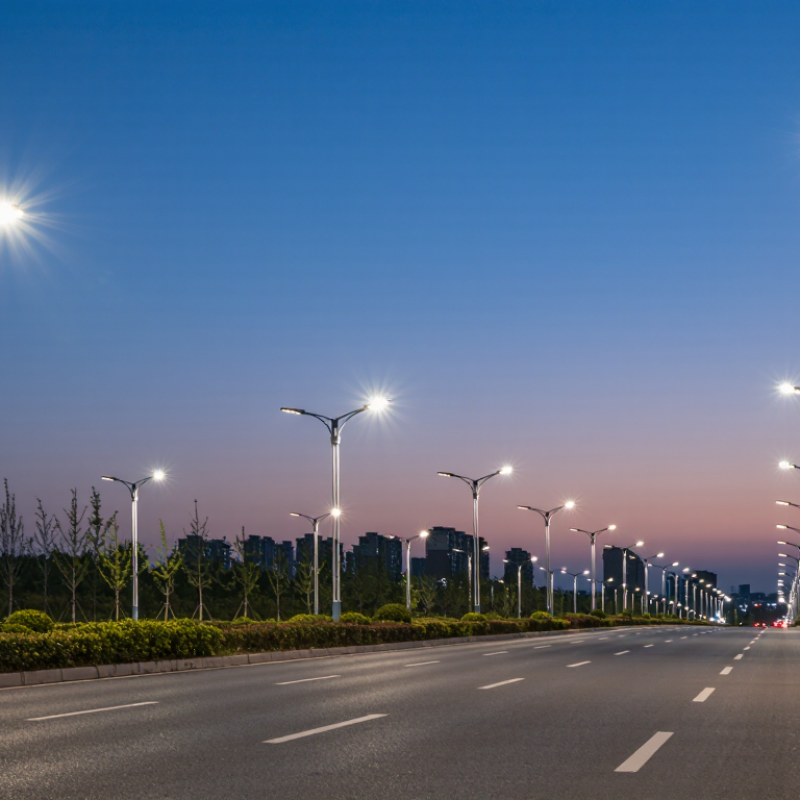
What Makes an LED Street Light a Top Choice for Global Buyers?
A top LED street light starts with measured performance, not a bright marketing claim. The International Energy Agency reports that lighting uses about 15% of global electricity. Efficient roadway systems can therefore create meaningful savings, especially across large municipal networks. Buyers should compare delivered lumens, wattage, optical distribution, and lifetime together. A higher lumen number is not automatically better.
Reliability matters in hot, wet, dusty streets. Look for tested protection levels, such as IP66 for dust and water resistance, and suitable impact protection under IEC 60598 requirements. The U.S. Department of Energy’s Solid-State Lighting R&D Opportunities report identifies laboratory LED efficacy above 200 lumens per watt, but commercial performance is usually lower. Request LM-80 and TM-21 evidence, thermal test results, surge protection data, and a complete photometric file. These documents reveal more than a product photograph.
Control compatibility also separates a practical choice from an expensive mistake. Dimming, photocells, motion sensors, and remote monitoring should work with local electrical infrastructure. Color temperature needs care. Very cool white light may improve visual contrast, yet it can increase glare and community concerns. I would test a sample at night before ordering thousands. Five-year warranties sound reassuring, but buyers should examine exclusions, replacement procedures, and local service capacity. The best specification can still fail when spare parts arrive slowly.
What Are the Top LED Street Lights for Global Buyers? - What Makes an LED Street Light a Top Choice for Global Buyers?
A practical benchmark table for evaluating LED street-light solutions across different climates, road classes, electrical systems, and public-infrastructure requirements.
| Evaluation Dimension | Recommended Benchmark for a Top Choice | Why It Matters | What Global Buyers Should Verify |
|---|---|---|---|
| System luminous efficacy | Approximately 130–200 lm/W at the complete luminaire level | Higher system efficacy can reduce energy consumption while maintaining the required road illuminance or luminance. | Request test data for the complete luminaire, not only the LED package. Confirm whether the stated value includes the driver, optics, thermal conditions, and operating current. |
| Rated power range | Common roadway configurations are approximately 30–180 W, selected according to road width, mounting height, spacing, and lighting class | A higher wattage does not automatically provide better road lighting. Correct optical design and spacing are equally important. | Check the photometric layout, pole spacing, mounting height, overhang, road width, and required lighting class before comparing wattage. |
| Light distribution | Road-specific asymmetric distributions, commonly described by roadway optical types such as Type II, Type III, or Type IV | The correct distribution places light on the carriageway and minimizes wasted light, dark areas, and unnecessary glare. | Ask for an IES or LDT photometric file and a project-specific lighting simulation. Avoid selecting a luminaire based only on beam-angle labels. |
| Correlated color temperature | 2700–3000 K 3000–4000 K 4000–5000 K | Warmer light can support glare and ecological considerations in sensitive areas, while neutral white light is commonly used for general roadway visibility. | Select the CCT according to local regulations, environmental policy, residential sensitivity, visibility needs, and user preference. |
| Color rendering index | CRI ≥70 for many standard roadway applications; higher CRI may be selected where object recognition is a priority | Adequate color rendering helps drivers and pedestrians distinguish objects, markings, and surroundings. | Confirm the minimum CRI, color consistency, and test method. Do not treat CRI as a substitute for proper photometric performance. |
| Useful service life | L70 of at least 100,000 hours is a strong target for long-term infrastructure projects | A longer rated life can reduce relamping, traffic control, labor, and maintenance costs. | Verify LM-80, TM-21, or equivalent LED lifetime evidence, the projected ambient temperature, driver life, and the definition of the stated L-value. |
| Ingress protection | IP66 or higher for the sealed luminaire enclosure | Protection against dust and powerful water jets is important for outdoor roads exposed to rain, dust, and vehicle spray. | Confirm that the IP rating applies to the complete assembled luminaire and that gaskets, cable entries, vents, and maintenance access points are included. |
| Impact resistance | IK08 or higher; IK09 or IK10 may be appropriate for vandalism-prone or high-risk locations | Impact resistance helps protect the housing, lens, and optical system from accidental or deliberate mechanical damage. | Check the impact rating under IEC 62262 or the applicable local standard, including the material and component tested. |
| Surge protection | At least 6 kV line-to-line and 6 kV line-to-earth; 10 kV protection is often preferred in exposed outdoor networks | Surge protection reduces the risk of damage caused by lightning-related transients and switching events. | Verify the test configuration, protection mode, replaceable surge protection device, grounding arrangement, and local utility requirements. |
| Operating temperature | Typically around −40°C to +50°C, with the exact range depending on the driver, housing, and control components | The operating range determines whether the luminaire can perform reliably in hot deserts, cold regions, coastal climates, or areas with severe seasonal variation. | Compare the specified ambient temperature with the project climate. Request thermal test information and confirm performance at the maximum rated temperature. |
| Thermal management | Passive heat dissipation through a corrosion-resistant metal housing, with no reliance on moving cooling fans | Effective thermal management helps preserve LED output, color stability, driver life, and gasket performance. | Review housing material, heat-sink design, thermal interface, LED junction-temperature data, and the cleaning or maintenance requirements. |
| Driver efficiency and power factor | Driver efficiency commonly above 90%; power factor typically ≥0.90 at rated load | An efficient driver reduces electrical losses, while a high power factor can improve network utilization and support utility requirements. | Request driver efficiency curves, power-factor data, total harmonic distortion data, standby consumption, and compatibility with the local voltage and frequency. |
| Input voltage compatibility | A wide-range driver suitable for the target grid, often covering approximately 100–277 VAC or 120–347 VAC, depending on the specification | Wide input compatibility can simplify deployment across countries with different low-voltage distribution systems. | Confirm nominal voltage, frequency, phase arrangement, tolerance range, earthing system, and compliance with local electrical regulations. |
| Glare and light control | Low-glare optics with controlled uplight and suitable shielding for the road geometry | Good glare control improves visual comfort and can reduce discomfort for drivers, pedestrians, and nearby residents. | Review BUG ratings or equivalent glare information, upward-light output, mounting tilt, shielding options, and the calculated glare metric required by the project. |
| Controls and dimming | At least programmable dimming; optional photocell, motion sensing, wireless control, or DALI/D4i-compatible interfaces | Adaptive lighting can lower energy use during low-traffic periods and provide operational data for maintenance planning. | Confirm control protocols, interoperability, cybersecurity provisions, fail-safe behavior, commissioning method, network coverage, and ownership of operating data. |
| Maintenance and serviceability | Tool-accessible components, replaceable surge protection, accessible driver, standardized connectors, and clear maintenance instructions | Serviceable construction can reduce downtime and total lifecycle cost when components eventually require replacement. | Check spare-parts availability, driver replacement procedure, connector standards, gasket replacement, cleaning access, and expected service labor. |
| Mechanical mounting | Adjustable side-entry or post-top mounting, commonly supporting pole diameters such as 42–60 mm or 60–76 mm, subject to the model | Correct mounting improves aiming, wind stability, installation flexibility, and compatibility with existing poles. | Verify mounting diameter, tilt adjustment, tightening torque, wind-load area, pole strength, cable entry, and anti-tamper hardware. |
| Photometric compliance | Tested according to applicable road-lighting and luminaire standards, with project calculations meeting the required uniformity and glare limits | Compliance demonstrates that the product is suitable for real roadway performance rather than only laboratory efficiency claims. | Request accredited laboratory reports, LM-79 or equivalent photometric data, IES/LDT files, and a calculation based on the actual installation geometry. |
| Warranty and documentation | A clearly defined 5–10 year product warranty, supported by technical files and replacement procedures | A transparent warranty reduces procurement risk and clarifies responsibilities for premature failures, lumen maintenance, and control-system defects. | Review warranty exclusions, geographic coverage, operating-hour limits, surge-related conditions, response times, spare-part policy, and required installation practices. |
| Total cost of ownership | Evaluate purchase price, energy use, maintenance, controls, installation, disposal, and expected service life together | The lowest initial price may not deliver the lowest lifecycle cost if energy consumption, failures, or maintenance are higher. | Use a project-specific lifecycle model with local electricity rates, annual operating hours, maintenance labor, replacement costs, financing, and expected dimming schedules. |
Related Posts
-

Innovative Trends in LED Street Lights Unveiled at 2025 China Import and Export Fair
-
Transforming Urban Safety: Case Studies on LED Street Lights and Challenges in Implementation
-
How to Choose the Best Solar LED Lights for Your Outdoor Spaces: A Comprehensive Tutorial
-
Global Export Certification: Top 5 Benefits of Choosing the Best LED Street Lights
-
Common Issues Faced When Choosing the Best Outdoor Solar Lights for Your Home
-
2024's Ultimate Guide: 15 Best Solar LED Lights for Sustainable Energy Savings
