Where to Buy China Top Camping LED Emergency Lights?
Where to Buy China Top Camping Led Emergency Lights? The answer requires more than comparing unit prices. It demands evidence, field experience, and careful supplier checks. The 2024 KOA North American Camping Report recorded 57.8 million camping households in the United States during 2023. That scale shows why dependable portable lighting matters. A dark tent, wet trail, or failed power bank can quickly turn convenience into a safety concern.
The U.S. Department of Energy reports that LED products use at least 75% less energy than incandescent lighting and can last up to 25 times longer. That advantage supports the growing demand for Camping Led Emergency Lights with efficient batteries, stable brightness, and longer service life. Lighting designer James R. Benya offers a useful principle: “Good lighting puts the right amount of light in the right place at the right time.” Buyers should apply that principle when reviewing Chinese manufacturers. Check lumen testing, battery capacity, charging cycles, IP ratings, emergency modes, and sample performance. Ask for test reports, not attractive claims.
Supplier experience matters. A factory may offer thousands of units, yet provide weak sealing or inconsistent cells. That is easy to miss in photographs. Request a pre-production sample. Test it outdoors. Record runtime at different brightness levels. Compare the result with the supplier’s specification. Some assumptions may be wrong. A low price is not always a saving. Reliable sourcing also requires traceable materials, clear warranty terms, and compliance documentation for the destination market.
Types of China-Made Camping LED Emergency Lights
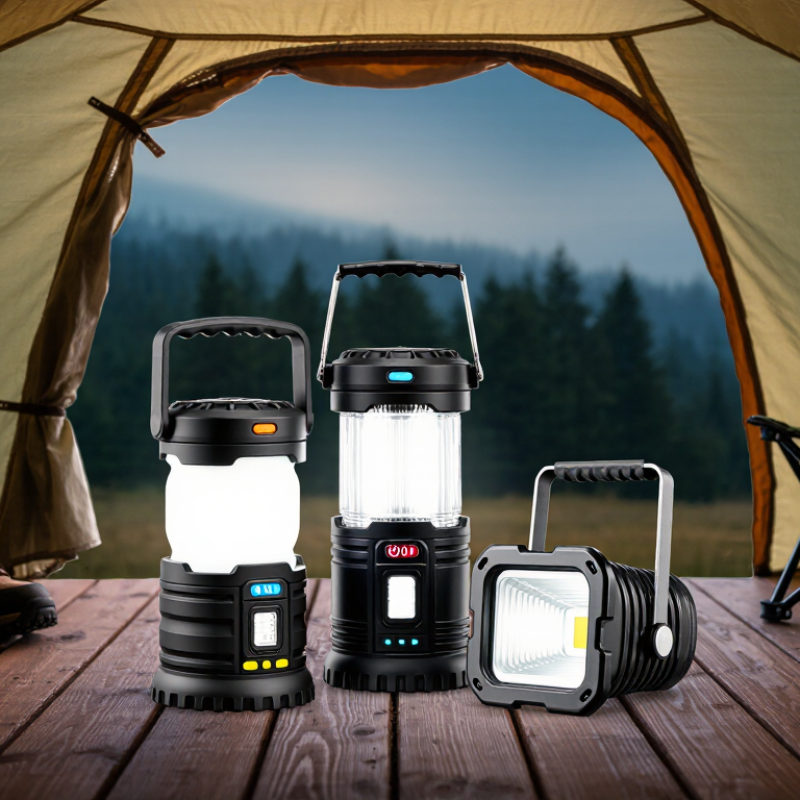
China-made camping LED emergency lights come in several useful types. Compact keychain lights suit short walks, tent zippers, and emergency kits. Lantern-style lights spread soft illumination across a table or shelter. Headlamps keep both hands free for cooking, climbing, or repairs. Some rechargeable models include USB charging, while solar-assisted versions help during extended outdoor stays. Battery-powered lights remain practical when charging access is limited.
For vehicle camping, consider high-lumen work lights with adjustable stands or magnetic bases. They can illuminate a cooking area or a flat tire. Waterproof portable lanterns are better for damp campsites, but check the IP rating carefully. A higher rating does not guarantee unlimited underwater use. Motion-sensor lights can save energy, although their sensors may react to insects or passing branches. That detail is easy to overlook.
Tips: Ask suppliers for battery capacity, runtime tests, charging specifications, and photometric data. Request sample units before placing a large order. Inspect switch quality, charging ports, diffuser strength, and heat control. A trustworthy manufacturer should provide clear test records and consistent product specifications. Do not choose only by brightness. A very bright light may drain quickly and disturb nearby campers. I would also compare replacement battery access, because a sealed battery can become inconvenient after repeated use. Small weaknesses often appear after several trips, not during a showroom demonstration.
Where to Buy China Top Camping LED Emergency Lights? - Types of China-Made Camping LED Emergency Lights
| Light Type | Typical Brightness | Common Power Source | Typical Runtime | Charging Method | Weather Protection | Best Camping Use | Recommended Buying Channel |
|---|---|---|---|---|---|---|---|
| Portable LED Lantern | 100–1,000 lumens | Replaceable batteries or built-in rechargeable battery | 4–100 hours, depending on brightness | USB-C, micro-USB, or disposable batteries | Usually IPX4 to IPX6 | Tent lighting, cooking areas, and campsite illumination | Outdoor retailers, online marketplaces, and direct factory quotations |
| Solar Camping Lantern | 50–500 lumens | Rechargeable lithium battery with solar panel | 6–30 hours after a full charge | Solar charging and USB backup charging | Typically IPX4 or IPX5 | Long trips, low-power camping, and emergency preparedness | Solar-product distributors, camping stores, and wholesale platforms |
| Rechargeable Emergency Lantern | 100–800 lumens | Built-in lithium-ion or lithium-polymer battery | 5–60 hours, depending on operating mode | USB-C or micro-USB; some models support power-bank output | Often IPX4 to IPX6 | Power outages, vehicle kits, and base camps | Emergency-equipment suppliers and online B2B sourcing platforms |
| Collapsible LED Lantern | 60–300 lumens | AA/AAA batteries or a small rechargeable battery | 6–40 hours | USB charging or replaceable batteries | Generally splash-resistant; commonly IPX4 | Backpacking, compact storage, and emergency kits | Camping retailers, gift-product wholesalers, and online marketplaces |
| LED Headlamp | 100–600 lumens | Rechargeable battery or AAA batteries | 3–80 hours, depending on mode | USB-C, micro-USB, or replaceable batteries | Usually IPX4 to IPX7 | Night hiking, repairs, fishing, and hands-free tasks | Outdoor distributors, sporting-goods retailers, and factory-direct sourcing |
| LED Flashlight with Emergency Modes | 200–1,500 lumens | Rechargeable lithium battery or replaceable cells | 2–100 hours, depending on output | USB-C, micro-USB, or external charger | Commonly IPX4 to IPX8 | Trail navigation, search use, and roadside emergencies | Professional lighting distributors and online outdoor-equipment stores |
| String LED Camping Light | 80–400 lumens total | Rechargeable battery, USB power, or solar battery pack | 5–50 hours | USB charging or solar charging | Commonly IP44 to IP65 | Decorative campsite lighting, awnings, and outdoor dining | Outdoor-lifestyle stores, event suppliers, and wholesale marketplaces |
Note: Specifications are typical market ranges for China-made camping LED emergency lights. Actual performance depends on LED efficiency, battery capacity, operating mode, enclosure design, and testing standards.
Key Features That Define High-Quality Emergency Lights
When choosing camping LED emergency lights from Chinese suppliers, examine performance rather than attractive product photos. A reliable light should provide measured brightness, stable output, and a beam that reaches beyond a nearby tent. Ask for test data at different battery levels. A high lumen number means little if brightness drops after ten minutes.
Battery quality defines emergency performance. Look for a protected lithium battery, clear capacity labeling, and dependable overcharge protection. USB-C charging is practical in camps and vehicles. A low-battery indicator prevents unpleasant surprises. Some models include solar charging, but this feature is often slow under cloudy skies. Treat it as backup power, not a complete solution.
Durability matters outdoors. An IP-rated housing helps resist rain, while impact-resistant plastic protects against drops on gravel. Check whether the switch works with wet fingers. Red light mode can preserve night vision and reduce disturbance inside a tent. A stable base, hanging hook, and magnetic back make placement easier. Small details count.
I have found that real runtime testing is more useful than catalog claims. Run the light for several hours before purchasing in quantity. Compare heat, brightness, charging time, and battery behavior. Ask Chinese manufacturers or trading suppliers for samples, inspection records, and applicable safety documentation. Communication can still fail over simple specifications. Confirm every measurement in writing.
Where to Find Reliable Chinese Camping Light Suppliers
Finding reliable Chinese camping light suppliers requires more than comparing online prices. Look for manufacturers with verified business registration, clear factory addresses, and several years of export experience. Trade fairs, professional sourcing platforms, and independent procurement agents can provide useful leads. Still, a polished profile proves little by itself.
Ask for product samples before discussing large orders. Test brightness, charging time, battery performance, switch durability, and heat control in realistic outdoor conditions. Check the lamp during rain and cold weather, not only under showroom lights.
Request material details, safety documents, and third-party test reports for the target market. A dependable supplier should explain each document clearly.
Communication matters. Reliable suppliers provide precise quotations, production schedules, packaging details, and replacement policies. Confirm the minimum order quantity and inspection process in writing.
I once focused too heavily on unit price and overlooked inconsistent battery labels. That mistake added delays. It also showed me that factory audits and pre-shipment inspections deserve a real budget. No supplier is perfect, but honest responses to difficult questions reveal more than attractive product photos. Ask how defects are recorded, who checks final goods, and what happens when specifications change. Small details often protect a camping light project from expensive surprises.
How to Compare Prices, Certifications, and Minimum Orders
When sourcing China-made camping LED emergency lights, compare delivered cost, not the factory quote alone. Add packaging, battery transport, inspection, and customs charges. A low unit price can become expensive after testing failures. The U.S. Department of Energy’s 2023 Solid-State Lighting report notes that advanced LED packages can exceed 200 lumens per watt in laboratory conditions. Field products perform lower, so request measured lumens, runtime, beam distance, and battery capacity. Ask for test photos with a calibrated integrating sphere. Suppliers sometimes report theoretical brightness. That is a weakness worth challenging.
Certifications need careful checking. For mains-powered emergency models, request evidence aligned with IEC 60598-2-22, plus applicable CE, RoHS, and battery transport documentation. A certificate number should match the exact model, battery, and factory. Generic laboratory paperwork is not enough. The 2024 Global E-waste Monitor reports 62 million tonnes of electronic waste generated in 2022, with only 22.3% formally collected and recycled. Replaceable batteries, repairable switches, and clear material declarations therefore deserve a price value. MOQ also changes the real comparison. One supplier may quote 100 units with plain cartons; another may require 500 units for custom colors, logos, or packaging. Request three tiers: sample, 100 units, and 500 units. Check lead time, spare parts, warranty terms, and pre-shipment inspection costs. I would not choose the cheapest offer too quickly. Small details decide reliability.
Steps for Choosing and Purchasing the Best Supplier
Choosing where to buy camping LED emergency lights from China starts with supplier verification, not a low quotation. Check the company’s registration, factory address, production history, and export experience. Request recent test reports for brightness, battery safety, charging performance, and water resistance. Reports should match the exact model you plan to purchase.
Ask for a sample before discussing a large order. Test it outdoors at night. Measure useful brightness, runtime, charging time, switch response, and heat around the battery compartment. Inspect the handle, lens, seals, and cable connection. A lamp may look powerful in photos but perform poorly after several hours. I once trusted a specification sheet too quickly. That mistake changed my inspection process.
Compare at least three suppliers using the same requirements. Confirm minimum order quantity, sample fees, production time, packaging details, spare parts, and warranty terms in writing. Ask how rejected units are handled and whether a pre-shipment inspection is possible. The supplier should explain battery transport documents and product compliance for your destination market. Start with a small trial order, then review defects, delivery accuracy, and communication speed. Price matters, but stable quality matters more.
